You Learn as You Go


About The Study
There are some bright spots in the Arkansas economy. GDP is growing faster than the national average, the state continues to attract new residents, and the outdoor recreation economy is thriving. Arkansas has more than its fair share of home-grown wealth generated by brilliant entrepreneurs and a diverse mix of natural resources. Plus, two of the last three winning Powerball Lottery tickets were bought in the state. By some measures, Arkansas is riding an impressive streak.
Despite these positive metrics, the financial struggles of many Arkansans are not trivial or isolated exceptions to the status quo.
The Women’s Foundation of Arkansas and Stone Bank commissioned this report to explore how women in Arkansas make financial decisions.
Emerging Themes
By analyzing existing publicly available data as well as new data collected from surveys and focus groups with women across Arkansas, the following themes emerged as important and consistent across the state:
-
Financial responsibility for many rural Arkansans is driven by insecurity, not abundance.
-
Most Arkansas women learn to manage money through trial-and-error, rather than formal financial education programs.
-
Pervasive aversion to debt and distrust of financial institutions reflect a need for psychological safety as much as financial preferences.
-
Women’s role in the economy is under-appreciated, even by the women themselves.
-
Entrepreneurship is often a necessity, not a choice.
-
Community banks play an essential stabilizing role in rural economies.
About the Women’s Foundation of Arkansas
Founded in 1998, the mission of the Women’s Foundation of Arkansas (WFA) is to ensure economic security for Arkansas women and girls through collaboration and focused philanthropic investment. Through grant making, research, and the Girls of Promise® and Women Empowered initiatives, the WFA is investing in real solutions that allow women and girls to move up the economic ladder and reach their fullest potential. The WFA is the only statewide foundation that focuses solely on women and girls in Arkansas. Learn more at womensfoundationarkansas.org.
About Stone Bank
Stone Bank is an Arkansas-based community bank with over $890M in assets. Stone Bank operates retail banking branch locations throughout Arkansas including Mountain View, Little Rock, Harrison, White Hall, DeWitt, and Gillett. Recognized nationally as a leading SBA, USDA, and FSA lender, Stone Bank combines local service with nationwide lending expertise. The bank’s corporate headquarters at 12615 Chenal Parkway in Little Rock. Stone Bank has been named one of Arkansas Business’s Best Places to Work in 2023, 2024, and 2025. Learn more at stonebank.com.
Rural Arkansas Women Facts and Figures
| Economic Status | Rural | Metro |
|---|---|---|
| More likely to be employed | x | |
| Higher household income | x | |
| Higher home ownership rates | x | |
| Less rent burdened | x | |
| More likely to have health insurance | x | |
| Less reliance on SNAP | x |
The financial status of households varies across metro and rural Arkansas. Data from the American Communities Survey (ACS) 2024 allows the direct comparison of households in the rural and metro areas of the state. More specifically, women in rural areas are less likely to be employed, and they tend to live in lower-income households with more reliance on food stamps or SNAP. Rural households, however, are more likely to be homeowners. On the other hand, women in metro areas live in households with higher incomes, but are more likely to be rent-burdened and less likely to have health insurance.
| Reasons | All Women | Rural | Metro |
|---|---|---|---|
| High fees | 19.0% | 18.8% | 19.2% |
| Not enough money | 16.8% | 19.5% | 14.9% |
| Concerned about information privacy | 12.1% | 13.8% | 10.9% |
| Inconvenient locations | 11.6% | 11.3% | 11.8% |
| Lack of Trust | 11.4% | 14.3% | 9.4% |
| ID Verification Challenges | 2.3% | 3.2% | 1.6% |
“I struggle a lot with my finances…I don’t trust people selling me things.”
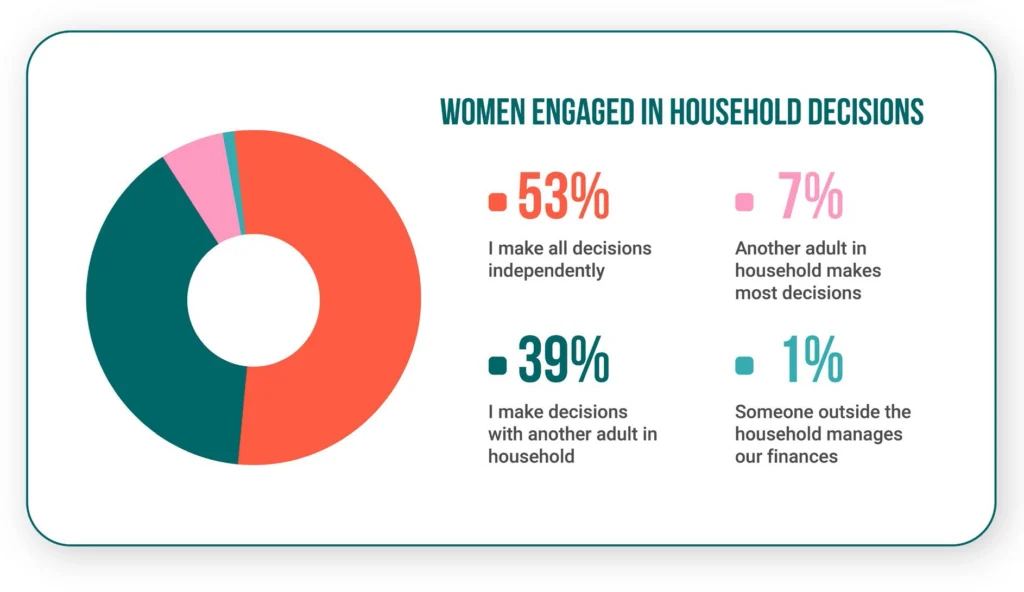
Women Engaged in Household Decisions
Over 92% of women in our survey report being actively involved or entirely responsible for household financial decisions.
| Household Decision Making | Percent of Women |
|---|---|
| I make all decisions independently | 53% |
| I make decisions with another adult in household | 39% |
| Another adult in household makes decisions | 7% |
| Someone outside the household manages our finances | 1% |
“You gotta know what’s more important and what’s on the higher priority list… What can wait and what can’t,” reflected one woman about her household’s budget.